Repository navigation
[RFC] ASoC:sof: fix FW loading failure in resuming occasion - #779
RanderWang wants to merge 3 commits into
Conversation


Why channel one possible to be allocated to capture stream since it(host dma channel 1) is already used by DMA trace? Is couple mode can couple the same channel index between host dma and link dma only? If so, is it possible that the commit dca70eb we did a month back( set couple -> program stream format -> set decouple) in hda_dsp_stream_hw_params() also introduce similar risk?
|


Because the allocation of link dma is independent of host dma. To copule different channel ? I don't find any register setting in spec.
No, first I removed this patch but still got error |
|
I also need to remove setting couple mode in host dma and I will update it tomorrow. Another solution is to check the usage of both host dma and link dma to set mode. But is there any benefit to set dma in couple mode when it is free ? |
RanderWang
changed the title

It's the recommended hardware sequence, so let's just follow it blindly rather than make conjectures on how hardware might work. Thanks! |

|
@RanderWang how about calling snd_hdac_ext_stream_decouple(bus, stream, true) in hda_dsp_trace_init() instead? |
There is another issue that: trace log is not updated after capture close. So your suggestion is not fit for this case. |
|
add detail in spec about decoupled and coupled bit: |
@RanderWang yes of course. thanks. |
|
@plbossart @RanderWang this seems like a nagging problem we've been dealing with because of trace DMA. Just wondering if it makes sense to maybe reserve channel 1 exclusively for trace? |
Yes, I just discussed with keyon and Mengdong, we should reserve max - 1 for trace and I will explain later. There is another bug my PR can't fix it. |
|
Even we never set coupled mode in stream close function, we would still have a bug about coupled mode setting. @keyonjie mentioned: the commit dca70eb we did a month back( set couple -> program stream format -> set decouple) in hda_dsp_stream_hw_params() would affect capture stream. The reason is: (1) capture stream 2 defined in topology would get HDC3 (host dma channel 3) and LDC2 (2) capture stream 1 would use HDC2 and LDC1, apply the sequence above: couple HDC2 and LDC2 (not LDC1 because HDC2 could only couple & decouple with LDC2). At this time capture stream 2 is broken. The issue is caused by DMA trace which makes other capture get mismatched channel number. We could To modify allocator for HDC and LDC is very tricky because HDC is allocated independent of LDC and their allocators are different. There is no such issue with skylake driver because there is no DMA trace to occupy the first channel. And last year we spent 3 months to debug and fix capture issue on HDA is also for this reason. |
|
@RanderWang I also think we need a way to disable trace DMA to quickly debug such problems. There's no simple way to do this today. |
I fully agree with you. Actually we discussed with @lgirdwood @xiulipan , but got no result. |
fb7b2b3 to
4b3555a
Compare
|
Update my PR. Now stream allocator would allocate last stream in list and DMA trace will use the stream with max valid stream tag to avoid occupying the stream tag one. I change the stream_get function because |

 plbossart
left a comment
plbossart
left a comment
There was a problem hiding this comment.
see big open on fundamental architecture assumptions below.
There was a problem hiding this comment.
Sorry, I don't get why a stream would need to have the same tag on both host and link DMA. This only makes sense if you have a passthrough flow, but the moment you start mixing two streams this assumption is no longer valid. Likewise if we have a stream that originates in the firmware, like tone generator, there will be no host DMA.
What am I missing?
|
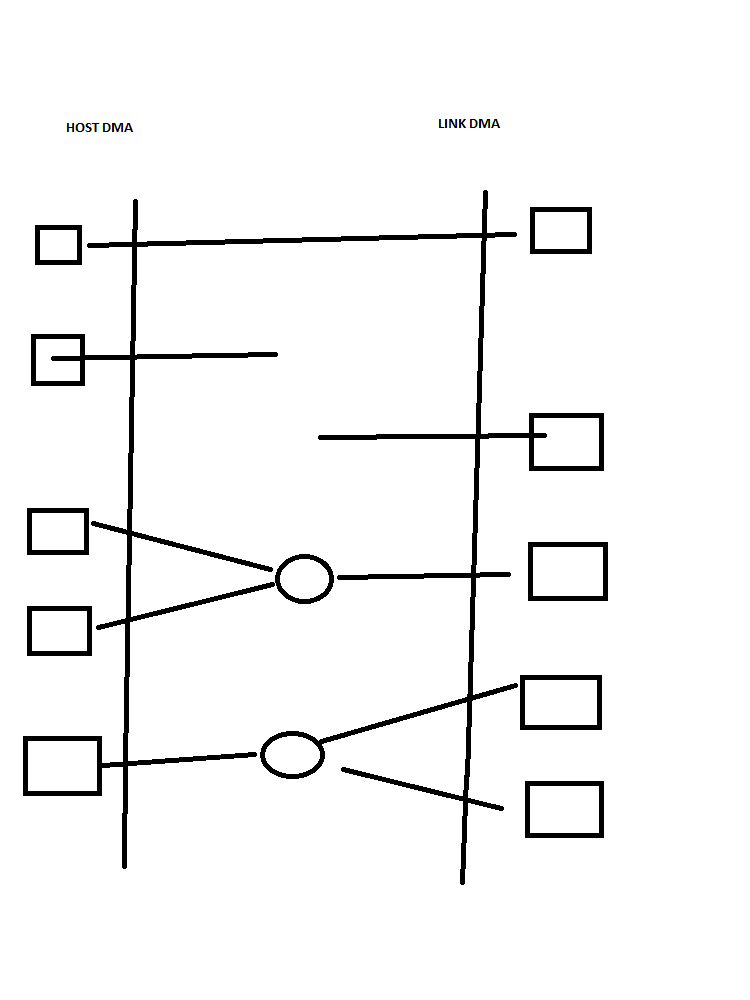
Good point! I just draw a picture to describe all the cases. To fix this is very complex for (1) host dma and link dma allocator are independent (2) link dma channels are allocated at topology loading time but host dma channels are allocated at pcm_hw_params. I don't want to introduce many new bugs and I would first check the sequence of coupled-set_format-decoupled
|
|
@RanderWang your picture is what I have in mind so at least on this we are in agreement. |
|
Thanks, I also hate submitting immature patch. I think we are in agreement about the solution about link dma usage. And now we find a coupled-decoupled issue, I discussed with keyon and got my solution. I think it is a complete one and need your advise. Now there are three kinds of hda|link dma allocation, the time sequence is DMA trace needs to be initiated before topology loading for we could use DMA trace to debug topology loading. And link dma allocation would only happens at topology loading time. When one pcm is opened, Now link dma allocation is complete for above picture. There is no need to change it. And for link dma allocation is not dynamically and it happens before all the pcm_open case, we could change host dma allocation to give a solution. In host dma allocation function for pcm_open which is for FE. (1) find a free host dma channel and check whether the matched (the same channel number) link dma channel is free. If both are free, return the host dma channel. It is easy to do this in driver. (2) if the matched link dma channel is used, check whether this is used by BE of this FE pcm. If yes, return (3) if not and there are some free channels, goto (1) to check next free host dma channel. (4) if there is no free channel, return error. Here one exception, host dma allocation for DMA trace, which happens before link dma allocation. The solution is allocating max channel done as this PR now. To use above algorithm in link dma allocator ? I implemented a prototype and tested it. Thanks for your idea! |
|
@RanderWang I appreciate the well-worded description, thank you for working on this. I have a conceptual issue on this point:
This is not clear to me. In the picture above, you can have a 1:N relationship between 1 FE and N BEs. So how would this work? Also I don't get what you are trying to do by trying to match host and link DMA numbers? Why is this needed in the first place? Is there any issue preventing us from using an independent allocation on the link and host sides, possibly with the trace pre-allocated? |
Yes, this works for this case. Please check the following explanation first. To set format, FE would couple host dma and link dma first and should not break other BE streams, only its own BE stream. So if one of the BE use the matched channel, The FE would only affect its own BE. For example, one FE has two BE which use link dma channel 1 and 2. FE could use host dma channel 1 or 2 because it will couple host dma channel 1 with link dma channel 1, or 2 with 2. This case would not break other BE steam with channel 3 or others.
This is for dynamic host dma only stream. Now only DMA trace is a example of this type.
It is caused by the patch for HW requirement. dca70eb. When we using an independent allocation, pcm stream would get different channel for host dma and link dma, and this would make playback or capture failed. For example (2) capture stream 1 would use HDC2 and LDC1, apply the sequence above to fix format issue: couple HDC2 and LDC2 (not LDC1 because HDC2 could only couple & decouple with LDC2). At this time capture stream 2 is broken. |
|
@RanderWang Are we in agreement that the connection between FE and BE is dynamic, and possibly controlled by mixer settings? If yes, please elaborate on your solution. I can see a corner case where a FE is initially connected to 2 BE using e.g ch 1 and 2, so the FE get host ch 1, but later the BE with ch1 is disabled so now we have the FE using host ch 1 and the remaining BE link ch 2. If your solution assumes a static connection between FE and BE, then you missed the 'dynamic' prefix of DPCM... |
If BE with ch1 is disabled, in step(2) the BE would not be found by this FE and this channel is used, so this ch1 can't be allocated by FE, and FE would check next ch2, which is fit for it. This BE finding algorithm is implemented in ASoC code, we can use it. |


There was a problem hiding this comment.
@RanderWang an alternate suggestion, trace dma channel will always be allocated even before tplg is loaded. So there is no possibility of a stream being open at this point. Why bother iterating then? Cant we just allocate list_last_entry?
There was a problem hiding this comment.
Yes, I also considered this solution. But there will be another reserved stream for buffer probing which is used for checking buffer content between each processing component in FW, we have to allocate list_second_last_entry.
There was a problem hiding this comment.
@RanderWang thanks. can you please educate me as to where this buffer probing is done?
There was a problem hiding this comment.
@keyonjie can you help to answer this question ? Thanks!

There was a problem hiding this comment.
@ranj063 the FW buffer probing feature is in our plan, we discussed that when in Gdansk @plbossart also there, it is used to probe buffers between components, dump contents to host side for debugging purpose, it will work similar to dma trace.
So here, we need to make sure our solution is extendable, there might be > 1 dailess capture streams in the future.
20190416:
When consider it more, those buffer probing pipelines are similar to normal I2S capture ones as their host dma indies are allocated in hw_params stage(after BE ones already allocated), so it looks doable to me just reserving the last index for DMA trace only.
@RanderWang please checking the existence of DMA trace when reserving this, we should make sure all those DMA trace related stuff can be excluded out via one kconfig item.
4b3555a to
75f7d36
Compare
|
Update my prototype, thanks for review. |
75f7d36 to
5d1c83c
Compare
You didn't get the point. If the BE with ch1 is disabled after the stream started, then you would have a case where the FE uses ch1 and the remaining BE use ch2. If that can work, then your algorithm is not necessary, you would use any mapping. If this does not work then we have a very large problem with link DMA support. |
yes, the algorithm is work for this case. when FE and BE are working, they are decoupled, so they don't affect each other. FW would copy data from host dma channel 1 to link dma channel 2. But for this case, if without the algorithm, there is another stream will allocated host channel 2, and couple with BE ch2, this breaks the FE in above case.
@plbossart First I quote the algorithm in dpcm. I think if BE with ch1 is disabled by dpcm, there will be a sequence of stop-and-reopen. The audio driver processes this as follows :- |
|
The above dpcm algorithm is for one case only, mixer and mux event would also dynamically change FE & BE also. But I am sure my algorithm could work with them. |
|
You didn't explain how, so that's not helping. |
|
So, I understand the the static link you comment. If FE is running and not closed, the host dma usage is static, and not change from ch1 to ch2 in above your case. I don't think there is a big problem. First host dma channel 2 can't be used by other FE stream, so it is not a waste of channel. and second host dma and link dma now are in decoupled mode, and FW would copy data correctly to make them work. |
For mixer case, just assume two FE and one BE. if there are three FEs and two BEs, FE1 <----> BE1(running), FE2 & FE3 <------> BE2 to be setup. For mux case, just assume two FE and one BE. FE1 <--------> BE1, FE2 is not connected. The allocation flow is like above. If FE2 is changed to connect BE1, and FE1 is not connect, we don't need to change our host dma allocation. |
|
One word to summary this PR: This PR is to fix two cases: |
|
How to fix? just avoid allocating the same host & link dma channel to different pcm stream. |
|
For mixer case, just assume two FE and one BE.
(1) BE use ch1
(2) first FE would get ch1 in step (2) in my algorithm. The FE set
coupled-decouple mode to set format, this would only affect BE with ch1
and not affect other stream.
(3) the second FE would get ch2 in step(1) in my algorithm for link dma
ch2 is not used, so the setting of coupled-decouple mode is safe.
if there are three FEs and two BEs, FE1 <----> BE1(running), FE2 & FE3
<------> BE2 to be setup.
BE1 uses ch1, BE2 use ch2, FE2 would get host dma ch2, and FE3 would get
host dma ch3. FE2 & FE3 will not affect FE1 and BE1
For mux case, just assume two FE and one BE. the flow is just like above.
I was talking about 1 FE and 2 BEs, with BEs selected by a kcontrol.
Please describe how this might work.
|
I understood your idea, but when I checked the code in ASoC and I only found mixer and mux would change the dpcm patch. The update function is: As I know, mixer and mux don't support 1:N(one FE works with N BEs), so I just explained the current status. @lgirdwood @keyonjie @bardliao Do you know whether dpcm supports 1 FE work with N BEs and how ? |
|
hi @RanderWang can we do some tests to check if the micro-seconds couple-decouple toggling(in the fixes for format setting) really introduce any issues(noise? hang?), if it looks fine in our real test, maybe it is wise to not spend big effort on discussion and try to design complicate channel index allocation algorithm which is actually hard to handle all possible nowaday's and future's mappings b/w host DMA and link DMA channel indices. |
|
@keyonjie , Yes I will. |
|
@plbossart For 1 FE and 2 BEs, with BEs selected by a kcontrol. I first talk about dpcm flow. And our two risks:seting couple mode for workaround at FE pcm_open and retoring couple mode at pcm_close. For 1 FE and 2 BEs case: there is no FE stream open, so there is no risk for workaround. But there is one I can't image other risks. And if you have one , please point out. Thanks! |
|
@plbossart @keyonjie The result is: I got big noise and XRUN happened, then aplay was broken. So the impact is great and we need to avoid this bug. |
d2ba204 to
053fe4a
Compare

This issue is found on WHL with pulse audio enabled.
Pulse audio would try to capture stream at booting stage,
then close the capture stream. This makes HDA controller
hang. The root cause is: DMA trace would use host dma
channel one, and capture stream would use link dma channel
one. DMA trace would set decouple mode for host dma channel
one and link dma channel one. Capture would also do as DMA
trace in hw_params function, but set couple mode for these
two dma when pcm is closed. However, DMA trace needs decouple
mode, so HDA controller hangs.

And another potential risk is when applying coupled and decopuled
mode for stream setup, this would break some working capture streams.
This patch refines the host stream allocation function to make sure
the allocated host stream would not affect other link streams.

Signed-off-by: Rander Wang <rander.wang@linux.intel.com>
If dma trace uses the first stream, it is hard to make
host dma and link dma channel matched.

Signed-off-by: Rander Wang <rander.wang@linux.intel.com>
Coupled mode setting may break other running streams.
For sof, only decoupled mode is needed, so hda stream
will be never set to coupled mode.

And the code style is refined in this patch.

Signed-off-by: Rander Wang <rander.wang@linux.intel.com>
053fe4a to
fe14bf9
Compare
|
Update my PR, break the solution to three parts Tested on WHL. |
plbossart
left a comment
plbossart
left a comment
There was a problem hiding this comment.
I have been asking for clarifications on why you need to have a match between link and host DMA channels. You keep providing the same patches without explanations.
I don't see any merit in all this. Link and host DMA channels are not described as needing to be tied in the hardware specification so NAK on this PR.
|
@plbossart , I explained many times, for example
|
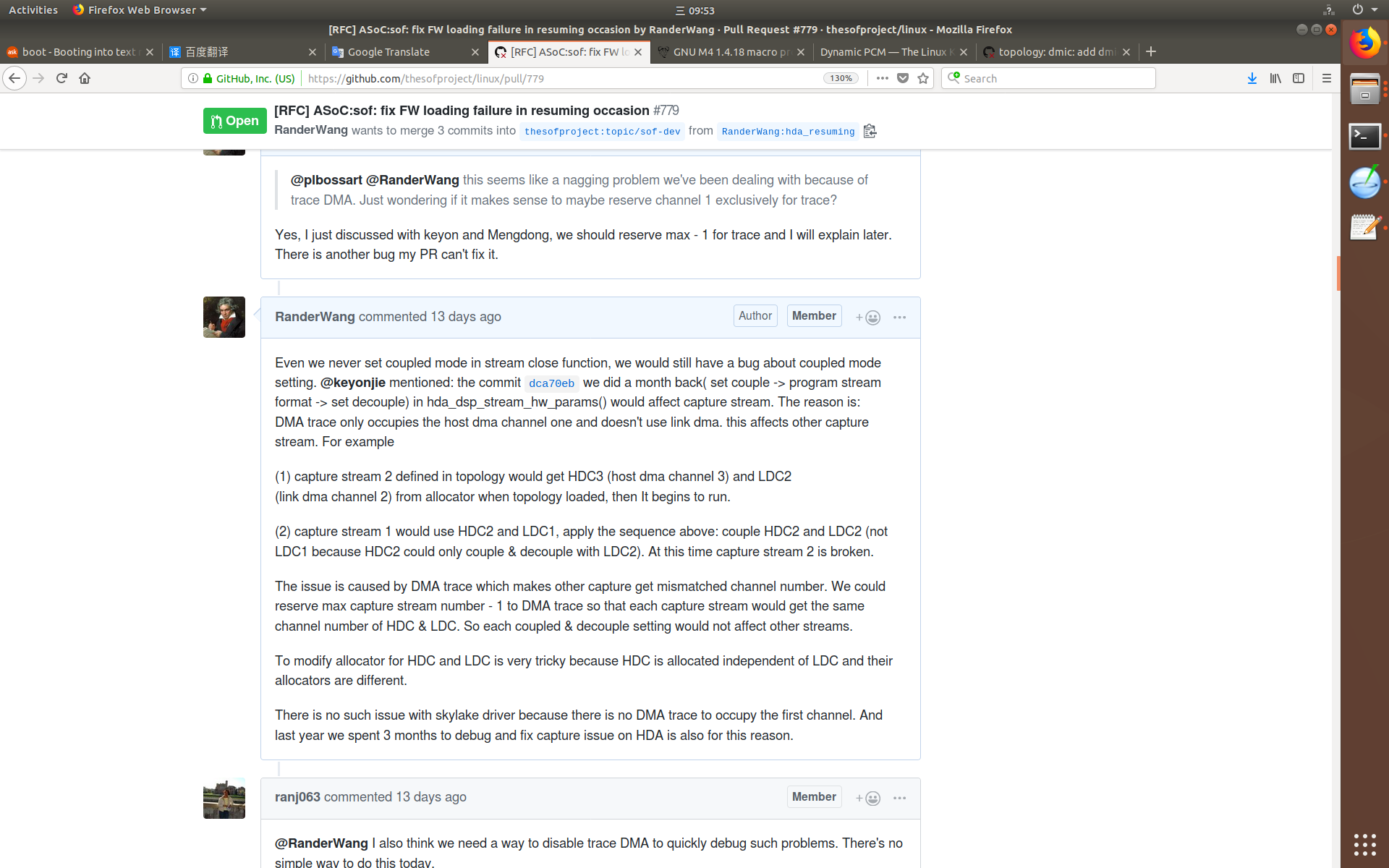


This issue is found on WHL with pulse audio enabled.
Pulse audio would try to capture stream at booting stage,
then close the capture stream. This makes HDA controller
hang. The root cause is: DMA trace would use host dma
channel one, and capture stream would use link dma channel
one. DMA trace would set decouple mode for host dma channel
one and link dma channel one. Capture would also do as DMA
trace in hw_params function, but set couple mode for these
two dma when pcm is closed. However, DMA trace needs decouple
mode, so HDA controller hangs.
And another potential risk is when applying coupled and decopuled
mode for stream setup, this would break some working capture streams.
Now allocate stream for DMA trace with max valid stream tag so
that the normal catpure stream tag allocated by host and link dma
allocator would be the same and the setting of coupled & decoupled
mode would not affect other streams. And also refine the host stream
allocation function to make sure the allocated host stream would not
affect other link streams.
fix #767