Repository navigation
put audio to D3 if no d0i3 compatible stream opened. - #1418
Conversation

 keyonjie
commented
Oct 31, 2019
keyonjie
commented


|
@keyonjie one more flag to add to the list of flags we already for D0i3 support? |


| /* power states related */ | ||
| enum sof_d0_substate d0_substate; | ||
| /* flag to track if the intended power target of suspend is S0ix */ | ||
| /* flag to track if the intended power target of the system is S0ix */ |

Yes, as explained in the replying to your detail comment, this was in my to-do list, if the conclusion is that we still need support D0ix in S0, then please help shed lights on:
|
|
@plbossart @keyonjie there are 2 different asks here:
"1" is a minor change in our current flow and easy to implement. "2" is a bigger ask and of course a mandatory one. I think we already discussed this and we want to go with the delayed work solution that the skylake driver has implemented. But I don't think we need to tie these two together at all. |
@keyonjie I dont think the latency of resuming from D0i3 will be noticeable enough to disable D0i3 in S0. Its as good or probably lesser than resuming from D3 in the case of runtime PM. I wouldnt worry about making this configurable if you ask me. If the DSP supports D0i3, it will be the only option. |
Thanks for summarizing @ranj063 Yes, @plbossart this PR only aims to fix "1". |

|
@keyonjie what I am asking is an infrastructure in place to deal with all possible transitions. It's ok if we don't implement all transitions, e.g. we could do the idle detection last, but I don't want to keep changing the code and adding new flags all the time. We have to show in our upstream contributions we understand what we are doing and the development follows a logical progression. This specific PR is an ad-hoc fix and it doesn't scale to the future cases, so let's do things right please. |
Got your point and understood your concern about adding flags now and removing them later, back and forth, let me try to make this PR more clear and scalable for adding runtime D0I3 support. |
@ranj063 that should work also, my point here is that using the flag d0i3_suspend is more straight-forward and efficient, so, with this new added one, we have 3 flags in total: d0_substate: to indicate if we are in D0 or D0I3 when the system is in S0, this will be useful for the coming D0I3 in S0 support. Using a separated d0i3_suspend flag will help for the configurable suspend/resume logic in the future, e.g. we could force to put audio DSP to d0i3 (if the platform support d0i3) for suspending always if it is required, then the logic might not be the suspend_ignored flag set there. |
@keyonjie you forgot "d0i3_compatible". For you and I, these all make perfect sense. For someone new to the implementation, it can be quite confusing to understand. In my opinion: only 2 flags are mandatory:
Everything else should be handled with appropriate logic. |
I think we are missing information on whether the platform supports S0ix or not. This is BIOS dependent and the kernel should know about it. |
@plbossart if the platform doesnt support S0ix, then S0_suspend would always be false isnt it? |
If the platform does not support S0ix, then we should remain in S0 if there is a D0ix_compatible stream. That means not changing the PCI state and stuff. |
Ahh I see. If S0ix is not supported, the audio power domain will not be power gated with the DSP in D0i3. This will prevent the S3 entry automatically right? |
not many double negatives for me... S0: D0, D0ix, D3 if S0ix is not supported, we still need to support S0 and S3. What's misleading is that 'suspend to S0' means different things depending if S0ix is supported or not. We don't have a 'suspend to S0ix', we have to infer it based on platform information when we get the 'suspend to S0' request. |
That is for stream, not sdev. for snd_sof_pcm_stream, we have one more actually :-), suspend_ignored.
If we don't have d0i3, how can people understand d0i3_compatible?
|
These make sense to me.
Sorry, @ranj063 don't catch your means by 'if the platform doesnt support S0ix' and 'don't have a suspend to S0ix', do you mean the case our .suspend() will not be called in some cases on some platforms? or we can't set 'freeze' to /sys/power/state, or can't set 's2idle' to /sys/power/mem_sleep ? |
@keyonjie that was Pierre's comment. But basically there can be platforms that only support S0 and S3. In such cases, if there are any D0i3 compatible streams running, we should suspend them and enter S3 when it is requested. |
In this case, the s0_suspend will be false, we will enter D3 with today's code. |
@keyonjie perfect thats what the question was about. |
|
@keyonjie in your next update for S0ix/D0i3, lets try to draw the state machine to show the transitions that are permitted to make it clearer |

| * d0i3_suspend = s0_suspend && D0I3 stream opened, | ||
| * D3 suspend = !d0i3_suspend, | ||
| */ | ||
|
|
There was a problem hiding this comment.
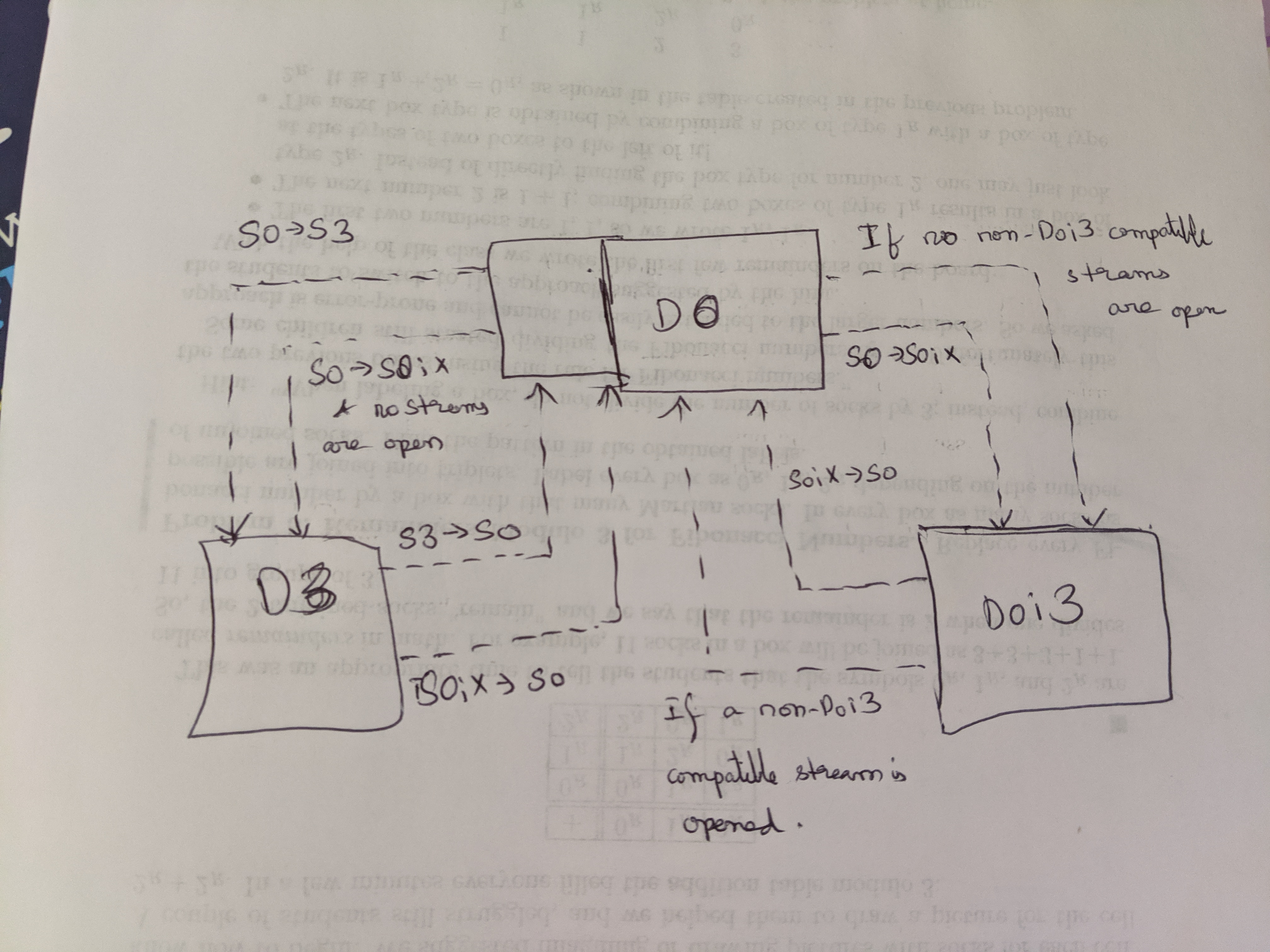
@keyonjie in my interpretation there are only 3 states for the DSP (D0, D0i3 and D3) So it is a bit confusing when your say D3 runtime-suspended and D3 suspended. Its not quite clear what it really means.
I made a simpler diagram. Let me know if you cant understand my handwriting. I may have missed something but I think this shows the transitions between the DSP states better.
There was a problem hiding this comment.
The above diagram only applies if the platform supports D0i3. The other thing is this diagram is intel specific. So needs to be moved there
There was a problem hiding this comment.
@keyonjie in my interpretation there are only 3 states for the DSP (D0, D0i3 and D3) So it is a bit confusing when your say D3 runtime-suspended and D3 suspended. Its not quite clear what it really means.
I made a simpler diagram. Let me know if you cant understand my handwriting. I may have missed something but I think this shows the transitions between the DSP states better.
Thanks, basically, I think your diagram is good to describe to DSP state transitions, except that it doesn't include:
- the runtime PM ops handling (the left-upper part in my diagram), we can treat the DSP state in runtime-suspended as a sub-state of D0 in your diagram, and don't care about its internal transition?
- the difference of S0 D0i3 and S0Ix D0i3. In your diagram, you try to include both in D0<-->D0i3, but it doesn't describe how should we handle when the S0Ix suspend arrive if we are already in S0 D0i3, which is we need to do here in pm.c:snd_sof_suspend/resume(). Yes, again, we can treat both S0-D0i3 and S0Ix-D0i3 as sub-states of D0i3 and ignore its internal transition here.
Then should we draw another diagram to describe the internal transition for '2' and '1'?
There was a problem hiding this comment.
I knew I missed something and yes the runtime PM case is important. Let me add it and send you a new diagram in a bit
There was a problem hiding this comment.
agree with Ranjani, there is no difference between runtime_suspended D3 and system_suspended D3. it's D3.
There was a problem hiding this comment.
um, it depends on how do you define the DSP state, e.g. we may put DSP to lower power state D0i3 when the system is in S0ix suspended, comparing with the S0 D0i3, so the flags in PM_GATE IPC will be different for them.
I am fine to use the simpler diagram here to make it easier for understanding, but we need to keep in mind that we still have difference scenarios(or called sub-state) inside both the D3 and D0i3 state, when we are in coding of the detail logic handling there.
There was a problem hiding this comment.
um, it depends on how do you define the DSP state, e.g. we may put DSP to lower power state D0i3 when the system is in S0ix suspended, comparing with the S0 D0i3, so the flags in PM_GATE IPC will be different for them.
@keyonjie Why would it be different in S0? Why cant you put the DSP in the same lower power D0i3 in S0?
For example, per my observation, in S0 D0i3, access to memory windows is possible, and we are planning to keep DMA trace active in this state for debug purpose, but when the system is entering S0ix, everything is changed, I don't have enough knowledge to explain how PMC will handling to the audio domain on S0ix entering, but I am quite sure the behavior of the Audio DSP in this S0ix D0i3 has difference with the one in S0 D0i3.
And, from the system point of view, we might need more normal interaction between FW & host in S0 D0i3 without putting the DSP back to D0, which is impossible in S0ix D0i3. When we are in S0ix D0i3, the only interaction between DSP and host is that the FW will send an IPC to wake the host up.
There was a problem hiding this comment.
Then you have different definitions of D0i3....
You should have one well defined behavior. If you have multiple behaviors, then you are not validating the same things.
I think the memory windows and DMA should only be allowed in D0i3_streaming. @mmaka1 and @lbetlej mentioned this state when we started this, and maybe it's time to formally recognize the difference between usages.
Oh yes, that is a major scenario of S0 D0i3, I think.
|
Hi @ranj063 , how about this diagram? |
@keyonjie I would not separate D3 and D0i3 (based on runtime PM or system suspend) at all. That gives an impression of them being 2 separate states when in fact there is no difference. |
Not to mention that D0i3 runtime does not exist - the transitions are not handled by pm_runtime but by an idle detection at the device level (orthogonal to pm_runtime). |
|
@keyonjie can you try and prioritize this, we have a number of QA tests failing because of the S0ix issues and s2idle being broken |
Sure, let me do this now. |
|
@plbossart @ranj063 updated. |
|
@keyonjie even though sequence you have seems OK, I am a bit uncomfortable with setting the sdev->d0i3_suspend flag every time a D0i3-compatible pipeline executing its TRIGGER suspend callback. If I were you, I would just check if we're entering S0ix and a D0i3-compatible pipeline is running in the suspend callback and make the decision |
|
@ranj063 makes sense, adding a helper to iterate the list, to remove usage of this extra flag now. |
| return NULL; | ||
| } | ||
|
|
||
| bool snd_sof_pcm_d0i3_suspend(struct snd_sof_dev *sdev) |
There was a problem hiding this comment.
@keyonjie fix commit message:
"Add helper to check if the DSP should be put in D0i3. This function returns true if a stream has ignored
the SUSPEND trigger to keep the pipeline running in the DSP"
There was a problem hiding this comment.
and why call it pcm_D0i3_suspend? I think snd_sof_dsp_D0i3_suspend() makes better sense no?

There was a problem hiding this comment.
and why call it pcm_D0i3_suspend? I think snd_sof_dsp_D0i3_suspend() makes better sense no?
The intention was to emphasize that it is from the view of the stream/pcm point as what we were doing inside is iterating the stream list only.
There was a problem hiding this comment.
The intention was to emphasize that it is from the view of the stream/pcm point as what we were doing inside is iterating the stream list only.
Right but what you're setting is the state for the DSP and not the pcm. So I dont think pcm in the name is relevant
| int ret; | ||
|
|
||
| if (sdev->s0_suspend) { | ||
| if (snd_sof_pcm_d0i3_suspend(sdev)) { |
There was a problem hiding this comment.
@keyonjie forgot to change the name here? and below?
There was a problem hiding this comment.
oops, my bad, shouldn't ignore compiling test for each change.
 ranj063
left a comment
ranj063
left a comment
There was a problem hiding this comment.
looks good now, thanks!
| int ret; | ||
|
|
||
| if (sdev->s0_suspend) { | ||
| if (snd_sof_dsp_d0i3_suspend(sdev)) { |
There was a problem hiding this comment.
the changes look odd.
in the resume() you call a suspend() operation, which means the naming isn't quite right.
snd_sof_dsp_d0i3_used() would make more sense to me.
There was a problem hiding this comment.
it's also confusing to use snd_sof_is_d0i3_suspend() in a resume() routine.
maybe snd_sof_dsp_d0i3_on_suspend() ?
There was a problem hiding this comment.
it's also confusing to use snd_sof_is_d0i3_suspend() in a suspend() routine.
maybe snd_sof_dsp_d0i3_on_suspend() ?
Sounds good, changing it now.

Add check before seeting d0_substate and return success if Audio DSP is
already in the target substate.

Signed-off-by: Keyon Jie <yang.jie@linux.intel.com>
Add helper to check if the DSP should be put in D0i3. This function
returns true if a stream has ignored the SUSPEND trigger to keep the
pipelines running in the DSP.

Signed-off-by: Keyon Jie <yang.jie@linux.intel.com>
We should suspend audio to D3 by default, for the sake of power saving,
change the condition of D0I3 suspending here to that when there is
stream with suspend_ignored specified.

Signed-off-by: Keyon Jie <yang.jie@linux.intel.com>
Add Audio DSP state machine with comments, be noticed that the
'D0<-->runtime D0I3' part is not implemented yet.

Signed-off-by: Keyon Jie <yang.jie@linux.intel.com>


