Repository navigation
vm module should expose V8::ScriptCompiler::CreateCodeCache #20052
Description
Activity
Note that the vm module already uses CreateCodeCache to emulate the deprecated kProduceCodeCache option.
I was going to do this but iirc got blocked by something, I can take a other look after my plane landsI remember now! we don't store the source text at the moment and I was going to ask people if they felt caching the source text was worth having this feature.Reacted by Yang GuoNow that I think about this, we should not actually need to pass the string. I'll fix this.
Reacted by snek- Reacted by snek, Linz and 舞影凌风
We don't throw any exception here. If anything, we'd just return nullptr. Not sure what the best way to report that is.
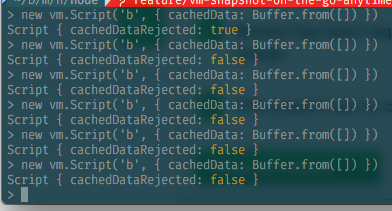
i don't mind v8 caching but it doesn't reflect the c++ api and is causing me great confusion, specially since i never gave it a valid cache which i assume means its just creating a cache anyway?
Yeah that's because the first time the cache was rejected, V8 compiled it and cached the result in memory. Further compiles simply hit the in-memory cache and V8 does not bother with the provided code cache.
@hashseed so just to make sure i understand:
- user passes invalid code cache
- create code cache internally to help out user
- all further scripts created with that string use the internal cache that has been created
assuming the above is accurate, how can node tell v8 not to do that or is there a better way we can expose code caches? maybe
vm.Script(source, { useCodeCache: true })?- User passes invalid code cache data
- V8 first checks the source string against the in-memory cache, and gets a cache miss
- V8 attempts to use the provided code cache data it, fails, and sets the reject flag
- V8 compiles the source on its own instead, and puts it into the in-memory cache, keyed by the source string
- User passes the invalid code cache with the same source string again
- V8 first checks the source string against the in-memory cache, and gets a cache hit
- V8 ignores the code cache data, and does not set the reject flag
V8 is not helping out the user. It's just that V8 has two tiers of caches, and the code cache is just the second tier. Is it a big issue that V8 would not reject the same code cache twice?
Is it required that an API returns the same result every time? The flag is not called
cacheIsValid. It's calledcachedDataRejected. Imo it's fine to not reject something that you do not use. Besides, there are many reasons why cache data may be rejected, including V8 flags being changed at runtime.Also, if V8 does not set the reject flag, it really doesn't break anything if the user provides the same invalid data the next time. I do see where you are coming from, but I don't think it's worth removing the in-memory caching tier (which arguably helps a lot) just to satisfy this requirement.
it's not the end of the world I suppose, just a difference in opinion (I prefer control over speed). I think for now since I changed the name to "codeCacheUsed" it's a bit less confusing anyway
You mean the API change of
cachedDataRejectedvscodeCacheUsed? I don't think that makes a difference, it just has easier-to-understand semantics.Or did you mean using the new
createCodeCache()vs producing cache data right after compilation viaproduce_cached_dataoption? If you callcreateCodeCache()right after compiling, there is virtually no difference. If you call it later, and the code cache includes more bytecode, then yes, there is a bit of a trade-off.createCodeCache()gives you the power to make that trade-off.Great! Thanks for the review!
Can this be closed since #20300 was merged?




Previously, V8 can only create code cache as part of compiling a script. Now V8 can created code cache from an UnboundScript at arbitrary time after compilation.
The advantages are: