Repository navigation
Populate co-authors from mentionable users from the GitHub API - #1476
Conversation


|
👋 Greetings @dmleong, @benbalter! This pull request addresses feedback that @dmleong had when we presented the co-author feature at Demo Day - because we were populating the co-author dropdown from local git history, it could include blocked users. After this change, the dropdown is populated by querying the GraphQL API for "mentionable" users within the current repository's GitHub remotes instead, which should exclude blocked users properly. We still fall back to using local git history if:
If a user opens Atom on a repository that doesn't satisfy these conditions and later it does (by adding remotes at the command line, for example) it will clear and re-populate accordingly. I wanted to check in with you to make sure that this was sufficient, and if there was anything else we could do to improve in this area 😄 |

|
Hi @smashwilson thanks for tagging us! Is there any way to remove any co-author suggestions from the list? I could see this being a problem if someone unexpected pops up and you would like to dismiss them from your list. |
Ah, there is not! That should be easy enough. What I'm thinking now:
The nice thing here is that this list will be respected across all of your Atom projects, even those that aren't backed by .com. An alternative would be to actually block users on .com when doing this. Would that be better? It feels a bit too aggressive for a keybinding you can trigger by mistake... |

| export default class GithubLoginModel { | ||
| // Be sure that we're requesting at least this many scopes on the token we grant through github.atom.io or we'll | ||
| // give everyone a really frustrating experience ;-) | ||
| static REQUIRED_SCOPES = ['repo', 'read:org', 'user:email'] |

There was a problem hiding this comment.
how hard would it be to leverage what we've built here into eventually having a unified Atom login experience? For Teletype, the GitHub package, and any other future packages that might want it?
There was a problem hiding this comment.
unified Atom login experience
I would love to have this so much. We'd need to find a way to make "GitHub identity" a part of the core API somehow, so that packages could just consume it. Maybe have a separate package that exists purely to handle the UI for authentication...
I'm not sure how much effort it would be. We'd need to scope it out first in an Atom RFC and get buy-in from the core team. Maybe we could wait to see how @shana can improve our authentication story first, and then generalize from there.
| } | ||
|
|
||
| const response = await fetch(host, { | ||
| method: 'HEAD', |
There was a problem hiding this comment.
TIL -- I didn't realize HEAD is a http method. (tho I guess there are all kindsa other weird ones like PURGE)
| if (a.name > b.name) { return 1; } | ||
| return 0; | ||
| }); | ||
| return this.users; |
There was a problem hiding this comment.
question...if users haven't created a GitHub access token, do we fall back on local git history? Or do we not populate the list of users at all?
There was a problem hiding this comment.
We fall back on local git history. We also clear the UserStore and fetch exclusively from GraphQL if a token does become available, or if a GitHub remote is added.
| return function fetchQuery(operation, variables, cacheConfig, uploadables) { | ||
| const currentToken = tokenPerEnvironmentUrl.get(url); | ||
| return fetch(url, { | ||
| if (atom.inSpecMode()) { |
There was a problem hiding this comment.
ohh, I did not know about inSpecMode but that's a good thing to know for telemetry
| @@ -616,8 +626,9 @@ export default class Present extends State { | |||
| // For now we'll do the naive thing and invalidate anytime HEAD moves. This ensures that we get new authors | |||
| // introduced by newly created commits or pulled commits. | |||
| // This means that we are constantly re-fetching data. If performance becomes a concern we can optimize | |||
There was a problem hiding this comment.
nit: is this comment still relevant since we have implemented some level of graphql caching?
There was a problem hiding this comment.
Ah, this particular comment is because it's used to pull authors from git history. Optimizing here would involve remembering the previous HEAD and only scanning the log of the difference, so we only need to parse a small number of commits each time... which would be tricky.

|
@smashwilson looks good to me! All my comments are basically "I can haz more context plz" not "suggestion on how to do this differently. |

|
One quick question: If an email address isn't found in the mentionable list, what happens? I agree, blocking a user from the Atom interface sounds much too easy, as you mentioned! |
Do you mean if a user has no public email address on their profile? In that case I'm currently inferring a noreply address from the login, which should let us populate the co-author trailer and pull the avatar properly. Edit: like so: if (node.email === '') {
node.email = `${node.login}@users.noreply.github.com`;
}Is this the preferred way to generate noreplies? Or should I be using an ID-based one instead? |
|
@smashwilson our preference is to only use publicly verified emails for this! This way, we ensure that there are no leaks to private emails or accounts |
|
@dmleong Hmm am I doing that wrong? When I was investigating the GraphQL API, it looked like mentionable users with email address privacy enabled were returned as empty strings: Re-reading the commit email address docs, it looks like I should be prepending the user ID, to correlate across username changes... although I can't find a way to pull the right user ID from the GraphQL API yet. But ID-based anonymized email addresses still leak the user login, right... ?
I suppose I'm not sure what you mean by "private account" and the best way to prevent leaking them 😅 |
|
@smashwilson I think we are discussing two different things regarding email privacy. Is the intention of using email addresses to find others who aren't in the mentionable users GraphQL API or is it to verify that they are mentionable users? If the users are already returned via GraphQL as mentionable, I think we are okay to proceed without email verification. Regarding a fallback using email addresses, I would prefer we only use public, verified email addresses to look up the user. I hope that clarifies things! |
We're using email addresses to:
If we query the GraphQL API, the co-author dropdown will show no users who are not returned by the GraphQL query - we use the mentionable user list as the source of truth. We will only include users from your git history if we don't have a way to get to GraphQL (and we clear them out if that changes, by logging in for example).
Okay, good 👍 Especially because I don't see a way to distinguish between verified and non-verified addresses in the API, hah. I thought that an account's primary email had to be verified regardless?
The only looking up we do is for avatar images, which uses whatever email is present in the git data. In the case of commits containing co-author trailers built with this UI, that's done with emails returned from GraphQL's user object, which are either public and verified or We don't stop users from manually adding private email addresses here:
... or by setting git's If we do have private email addresses in your git history, we'll leak them to someone sniffing your network traffic in the form of HTTP requests to I think you could also expose a co-author's private email address within git history by mistake if you enter it yourself. Does the "block pushes" setting apply to co-author trailers, too... ? Otherwise I don't know how to detect that, either. The help docs around co-authors imply that this is the committer's responsibility when composing the message:
|
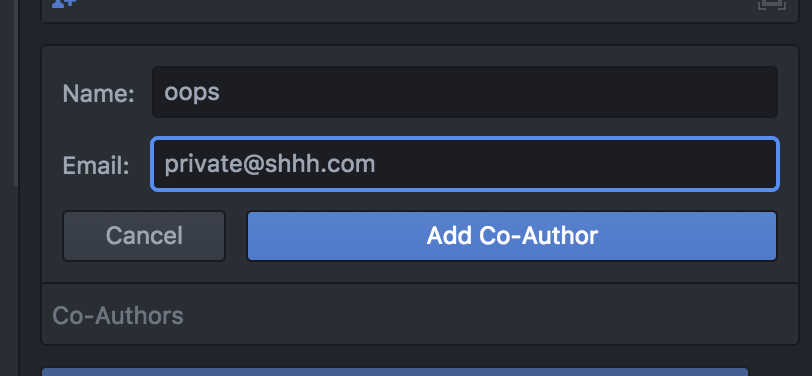
|
@smashwilson thank you for the thorough explanation! Let's go ahead and proceed with what you had. It looks like since it's git data, there's not a whole lot of protection we can use (since git is inherently built this way) and we can use commit signing as a form of security on the end user's side. |
|
@dmleong 🙇Thanks for your input and for bearing with my long-windedness 😄 Co-author exclusion is in; authors can be excluded by pressing |
4 participants


If the current repository has one or more remotes hosted on a GitHub instance and you've authenticated to that instance on the GitHub tab, fetch the "mentionable" users from the GraphQL API rather than the local git history. This will give us GitHub usernames which we can use for autocompletion, and, importantly, it will omit users who have been blocked by the current user.
Along the way, I'm building out some infrastructure we can use to test components that query GraphQL.
RelayNetworkLayerManager.Authormodel now that we have enough data to warrant oneUserStorestorage to pre-sort authorsModelObserverwithin theUserStoreto watch theRepositoryand reload authors when it broadcasts a changeUserStorethrough the component tree as a prop. Extract authors with an<ObserveModel>component closer to the co-author field.shift-delete