Skip to content
This repository was archived by the owner on Mar 20, 2023. It is now read-only.

Link errors when generating special-core with kinetic scheme NMOD files #303

Closed

Description

@pkuzyc

Hello. I can successfully generate "special-core" using nrnivmodl-core with some general NMOD files. However, when there are some NMOD files implemented with kinetic scheme, it failed.

I used nrnivmodl-core with command:
./nrnivmodl-core /path/to/nmodfiles
and the errors are:

coreneuron/coreneuron.cpp:
@E@nvlink error   : Undefined reference to '_ZN10coreneuron13sparse_threadEPNS_9SparseObjEiPiS2_PddiiiiS3_S2_PNS_11ThreadDatumEPNS_9NrnThreadEd' in 'x86_64/libcorenrnmech.a:ca_ch.o'
@E@nvlink error   : Undefined reference to '_ZN10coreneuron17_ss_sparse_threadEPNS_9SparseObjEiPiS2_PddiiiiS3_S2_PNS_11ThreadDatumEPNS_9NrnThreadEd' in 'x86_64/libcorenrnmech.a:hcn12_ch.o'

It seems that it's about the function sparse_thread? Could you please take a look at it? Thank you.

Activity

  1. cattabiani commented on May 15, 2020

    @cattabiani
    Contributor

    Hello there!

    could be useful to check also the modfile. Do you have a toy example where this appears?

  2. pkuzyc commented on May 15, 2020

    @pkuzyc
    Author

    Here are the code of two example mod files:

    ca_ch.mod:

    :Migliore file Modify by Maciej Lazarewicz (mailto:mlazarew@gmu.edu) May/16/2001
    
    TITLE Calcium ion accumulation and diffusion
    : The internal coordinate system is set up in PROCEDURE coord_cadifus()
    : and must be executed before computing the concentrations.
    : The scale factors set up in this procedure do not have to be recomputed
    : when diam1 or DFree are changed.
    : The amount of calcium in an annulus is ca[i]*diam1^2*vol[i] with
    : ca[0] being the second order correct concentration at the exact edge
    : and ca[NANN-1] being the concentration at the exact center
    
    NEURON {
    	SUFFIX ca_ch
    	USEION ca READ cao, cai, ica WRITE cai, ica
    	RANGE ipump,last_ipump,test
    	RANGE DFree, k1buf, k2buf, k1, k2, k3, k4, totpump, totbuf
    	RANGE vol, Buffer0
    }
    
    DEFINE NANN  4
    
    UNITS {
            (mol)   = (1)
    	(molar) = (1/liter)
    	(mM)	= (millimolar)
    	(um)	= (micron)
    	(mA)	= (milliamp)
    	FARADAY = (faraday)	(10000 coulomb)
    	PI	= (pi) 		(1)
    }
    
    PARAMETER {
    	DFree	= .6	(um2/ms)
    	diam 	= 1	(um)
    	cao		(mM)
    	ica		(mA/cm2)
    	k1buf 	= 500	(/mM-ms)
    	k2buf 	= 0.5	(/ms)
            k1	= 1.e10 (um3/s)	
            k2	= 50.e7 (/s)	: k1*50.e-3
            k3	= 1.e10 (/s)	: k1
            k4	= 5.e6	(um3/s)	: k1*5.e-4
    	totpump	= 0.2	(mol/cm2)
    	totbuf	= 1.2	(mM)
    } 
    
    CONSTANT { volo=1  (liter)}
    
    ASSIGNED {
    	area		(um2)
    	test
    	cai		(mM)
    	vol[NANN]	(1)	: gets extra cm2 when multiplied by diam^2
    	ipump           (mA/cm2)
    	last_ipump	(mA/cm2)
    }
    
    STATE {
    	ca[NANN]	(mM) <1.e-5> : ca[0] is equivalent to cai
    	CaBuffer[NANN]  (mM)
    	Buffer[NANN]    (mM)
            pump            (mol/cm2) <1.e-3>
            pumpca          (mol/cm2) <1.e-15>
    
    }
    
    BREAKPOINT {
    	SOLVE state METHOD sparse
    	:SOLVE state METHOD cnexp
    	last_ipump=ipump
    	ica = ipump
    	test = 0
    }
    
    LOCAL coord_done
    
    INITIAL {
    	if (coord_done == 0) {
    		coord_done = 1
    		coord()
    	}
    	: note Buffer gets set to Buffer0 automatically
    	: and CaBuffer gets set to 0 (Default value of CaBuffer0) as well
    	FROM i=0 TO NANN-1 {
    		ca[i] = cai
    	}
     
           	ipump 	= 0
            pump 	= totpump
            pumpca 	= (1e-18)*pump*cao*k4/k3
    
            FROM i=0 TO NANN-1 {
                   	ca[i] = cai
    		CaBuffer[i] =(totbuf*ca[i])/(k2buf/k1buf+ca[i])
    		Buffer[i] = totbuf - CaBuffer[i]	
    	}
    }
    
    LOCAL frat[NANN] 	: gets extra cm when multiplied by diam
    
    PROCEDURE coord() {
    	LOCAL r, dr2
    	: cylindrical coordinate system  with constant annuli thickness to
    	: center of cell. Note however that the first annulus is half thickness
    	: so that the concentration is second order correct spatially at
    	: the membrane or exact edge of the cell.
    	: note ca[0] is at edge of cell
    	:      ca[NANN-1] is at center of cell
    	r = 1/2					:starts at edge (half diam)
    	dr2 = r/(NANN-1)/2			:half thickness of annulus
    	vol[0] = 0
    	frat[0] = 2*r
    	FROM i=0 TO NANN-2 {
    		vol[i] = vol[i] + PI*(r-dr2/2)*2*dr2	:interior half
    		r = r - dr2
    		frat[i+1] = 2*PI*r/(2*dr2)	:exterior edge of annulus
    					: divided by distance between centers
    		r = r - dr2
    		vol[i+1] = PI*(r+dr2/2)*2*dr2	:outer half of annulus
    	}
    }
    
    LOCAL dsq, dsqvol : can't define local variable in KINETIC block or use
    		:  in COMPARTMENT
    KINETIC state {
    	COMPARTMENT i, diam*diam*vol[i]*1(um) {ca CaBuffer Buffer}
            COMPARTMENT (1.e10)*area {pump pumpca}
            COMPARTMENT (1.e15)*volo {cao}
    
    	~ ca[0] << (-(ica-last_ipump)*PI*diam*frat[0]*1(um)/(2*FARADAY))
    
    	FROM i=0 TO NANN-2 {
    		~ ca[i] <-> ca[i+1] 	(DFree*frat[i+1]*1(um), DFree*frat[i+1]*1(um))
    	}
    
    	dsq = diam*diam*1(um)
    	FROM i=0 TO NANN-1 {
    		dsqvol = dsq*vol[i]
    		~ ca[i] + Buffer[i] <-> CaBuffer[i] (k1buf*dsqvol,k2buf*dsqvol)
    	}
    
            ~ca[0] + pump <-> pumpca 	((1.e-11)*k1*area, (1.e7)*k2*area)
            ~pumpca       <-> pump + cao 	((1.e7)*k3*area, (1.e-11)*k4*area)
    
            ipump = 2*FARADAY*(f_flux-b_flux)/area
    
    	cai = ca[0]
    }
    	
    COMMENT
    At this time, conductances (and channel states and currents are
    calculated at the midpoint of a dt interval.  Membrane potential and
    concentrations are calculated at the edges of a dt interval.  With
    secondorder=2 everything turns out to be second order correct.
    ENDCOMMENT
    

    hcn12_ch.mod:

    COMMENT
    
    Josh Held's adaptation to suit HCN1+2.  12/22/2003
    
    ****
    Kinetic model of HCN2 channel gating from Wang et al 2002.
    
    In this model channel opening is coupled to a change in the affinity of the cyclic nucleotide binding domain for cAMP which is manifest as a shift in the activation curve toward more positive potentials.  This model explains the slow activation kinetics of Ih associated with low concentrations of cAMP.
    
    For further details email Matt Nolan at mfnolan@fido.cpmc.columbia.edu.
    
    Reference
    
    Wang J., Chen S., Nolan M.F. and Siegelbaum S.A. (2002). Activity-dependent regulation of HCN pacemaker channels by cyclicAMP: signalling through dynamic allosteric coupling. Neuron 36, 1-20.
    ****
    ENDCOMMENT
    
    NEURON {
    	SUFFIX hcn12_ch
    	NONSPECIFIC_CURRENT i
    	RANGE i, ehcn, g, gbar
    	RANGE a0, b0, ah, bh, ac, bc, aa0, ba0
    	RANGE aa0, ba0, aah, bah, aac, bac
    	RANGE kon, koff, b, bf, ai, gca, shift
    }
    
    UNITS {
    	(mV) = (millivolt)
    	(molar) = (1/liter)
    	(mM) = (millimolar)
    	(mA) = (milliamp)
    	(S) = (siemens)
    }
    
    PARAMETER {
    	gbar    = 1		(S/cm2)
    	ehcn    = -20		(mV)
    	a0      = .006		(/ms)	: parameters for alpha and beta
    	b0      = .0008		(/ms)
    	ah      = -96		(mV)
    	bh      = -51.7		(mV)
    	ac      = -.155		(/mV)
    	bc      = .144		(/mV)
    	aa0     = .0006		(/ms)	: parameters for alphaa and betaa
    	ba0     = .004		(/ms)
    	aah     = -94.2		(mV)
    	bah     = -35.5		(mV)
    	aac     = -.075		(/mV)
    	bac     = .144		(/mV)
    	kon     = 30		(/mM-ms) : cyclic AMP binding parameters
    	koff    = 4.5e-05	(/ms)
    	b       = 80
    	bf      = 8.94
    	ai	= 1e-05		(mM)	:concentration cyclic AMP
    	gca     = 1			: relative conductance of the bound state
    	shift   = -17		(mV)	: shift in voltage dependence
    	q10v    = 4                     : q10 value from Magee 1998
    	q10a    = 1.5			: estimated q10 for the cAMP binding reaction
    	celsius			(degC)
    }
    
    ASSIGNED {
    	v	(mV)
    	g	(S/cm2)
    	i	(mA/cm2)
    	alpha	(/ms)
    	beta    (/ms)
    	alphaa	(/ms)
    	betaa	(/ms)
    }
    
    STATE {
    	c
    	cac
    	o
    	cao
    }
    
    INITIAL {
    	SOLVE kin STEADYSTATE sparse
    	:SOLVE kin STEADYSTATE cnexp
    }
    
    BREAKPOINT {
    	SOLVE kin METHOD sparse
    	:SOLVE kin METHOD cnexp
    	g = gbar*(o + cao*gca)
    	i = g*(v-ehcn)
    }
    
    KINETIC kin {
    	LOCAL qa
    	qa = q10a^((celsius-22 (degC))/10 (degC))
    	rates(v)
    	~ c <-> o       (alpha, beta)
    	~ c <-> cac     (kon*qa*ai/bf,koff*qa*b/bf)
    	~ o <-> cao     (kon*qa*ai, koff*qa)
    	~ cac <-> cao   (alphaa, betaa)
    	CONSERVE c + cac + o + cao = 1
    }
    
    PROCEDURE rates(v(mV)) {
    	LOCAL qv
    	qv = q10v^((celsius-22 (degC))/10 (degC))
    	if (v > -200) {
    		alpha = a0*qv / (1 + exp(-(v-ah-shift)*ac))
    		beta = b0*qv / (1 + exp(-(v-bh-shift)*bc))
    		alphaa = aa0*qv / (1 + exp(-(v-aah-shift)*aac))
    		betaa = ba0*qv / (1 + exp(-(v-bah-shift)*bac))
    	} else {
    		alpha = a0*qv / (1 + exp(-((-200)-ah-shift)*ac))
    		beta = b0*qv / (1 + exp(-((-200)-bh-shift)*bc))
    		alphaa = aa0*qv / (1 + exp(-((-200)-aah-shift)*aac))
    		betaa = ba0*qv / (1 + exp(-((-200)-bah-shift)*bac))
    	}
    }
    
    
  3. cattabiani commented on May 15, 2020

    @cattabiani
    Contributor

    sorry but I forgot to mention: do you use mod2c or nmodl in coreneuron?

  4. pkuzyc commented on May 15, 2020

    @pkuzyc
    Author

    I used nrnivmodl-core to generate the file "special-core", and the command I used is: ./nrnivmodl-core /path/to/mod

  5. cattabiani commented on May 15, 2020

    @cattabiani
    Contributor

    yes but, coreneuron (and thus nrnivmodl-core) was built with nmodl or mod2c activated?

  6. pkuzyc commented on May 15, 2020

    @pkuzyc
    Author

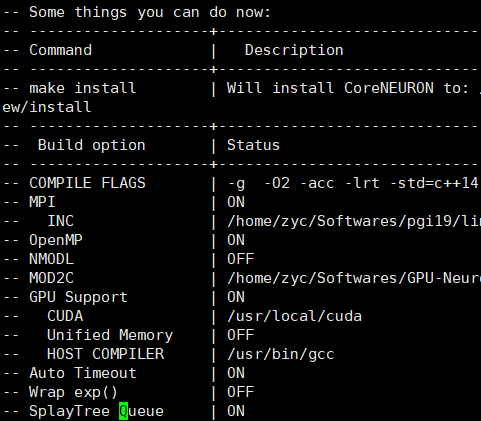
    With mod2c activated, here are some outputs in compiling:
    WeChat Screenshot_20200515235144

  7. cattabiani commented on May 15, 2020

    @cattabiani
    Contributor

    Thank you very much! We will investigate on this

  8. added a commit that references this issue on May 19, 2020
    37337b1
  9. pramodk commented on May 19, 2020

    @pramodk
    Collaborator

    Sorry for delay @pkuzyc ! #307 should fix the link error you have reported.

    One of the thing I would like to mention here is the the default MOD file to C++ converter we are using (https://github.com/BlueBrain/mod2c) doesn't generate optimal code for GPU/CPU especially for the KINETIC blocks.

    New translator we are working on (https://github.com/BlueBrain/nmodl) has much better support but currently has one issue for GPU. We are still working on a fix.

    I would be curious to know the performance you get. If you have any issues, please let us know.

  10. added a commit that references this issue on May 19, 2020
    02b5550
  11. added a commit that references this issue on Nov 2, 2022
    660fec2
Sign up for free to join this conversation on GitHub. Already have an account? Sign in to comment

Metadata

Metadata

Assignees

Labels

Type

No type

Projects

No projects

    Milestone

    No milestone

    Relationships

    None yet

    Development

    No branches or pull requests

    Issue actions