Repository navigation
Create receive page in payments section - #240
Conversation


Co-authored-by: Christoph Ono <chri@sto.ph>

|
As I had quite a lot of feedback on the text I copied the text into a doc and made suggestions there instead of clogging up this PR: https://docs.google.com/document/d/1PMgMIZ1fkC3SqJKWQBOrmJxefjmZhktqbSPZfzabmrE/edit?usp=sharing |

 pavlenex
left a comment
pavlenex
left a comment
There was a problem hiding this comment.
Great work really, I like the structure and the fact this page points out and tries to tackle some really common UX and even privacy problems by default (paying to legacy wallet, address re-use).
I feel like it lacks an illustration or two to better visualize what we mean. And the biggest thing that lacks here is more decisive recmendation, for SegWit with an option to switch (should be formatted in do's and don'ts) as I don't think it's clear for a designer what they should use.

| --> | ||
|
|
||
| ## Choosing the type of address | ||
| There are currently [three different versions](https://bitcoin.design/guide/glossary/#address) of bitcoin addresses. In order of oldest to newest they are; Legacy, Script, and SegWit. It is best practice for new applications to support SegWit, the latest, by default. |

|
|
||
| **Sixth confirmation** -- from this point the payment is finalized, it should be no problem to spend freely. | ||
|
|
||
| If your application has an area where the user can see a list of payment requests, this would be a good place to use it to also indicate which specific stage the payment is in. |
There was a problem hiding this comment.
There are several screens with lists of transaction in the wallet UI kit we can use here. Check it.

Co-authored-by: Daniel Nordh <daniel@mutinyserver.com>

| Although addresses are not a problem to share publically, their accompanying private keys which typically generated from a single recovery phrase must be kept secure and private. | ||
| --> | ||
|
|
||
| ## Creating an invoice |
There was a problem hiding this comment.
@GBKS @pavlenex thoughts on referring to generating an address and adding metadata to it as an invoice? I previously called it payment requests, and @danielnordh prefers that as it is less corporate/businessy.
There was a problem hiding this comment.
I find invoice to be more of business term than payment request (thinking about which terms I'd use with friends vs. business purposes). So my vote would be for payment request (despite it being longer).
There was a problem hiding this comment.
I prefer an invoice, easier to translate, the payment request is not a regular term in my opinion.
There was a problem hiding this comment.
When we start talking about LN, it's all about invoices there, and some of the additional data is going to be more built-in.
Invoice
- https://en.bitcoin.it/wiki/Invoice_address
- https://github.com/lightningnetwork/lightning-rfc/blob/master/11-payment-encoding.md
Payment Request
👆 this is old deprecated BIP but still has some good ideas around signed messaged that will probably be rehashed.

There was a problem hiding this comment.
I commented a bit more on this part in the doc
My feedback is basically:
- If 'invoice' is not a defined standard in Bitcoin, let's not push for it as it doesn't really make sense for end users (maybe for merchants, but that's not what we are tackling here)
- We don't not need to talk about this as creating an 'object', so instead of saying 'Create an invoice/payment request', we can simply say 'Requesting bitcoin' as a subtitle. For the user it's an action, not an object.
- IF the user is asked/able to enter additional information other than the address, it should be clear to them if that information is SHARED with the person they want to request bitcoin from, or not
The subtitle and the following paragraph could then be:
Requesting bitcoin
The simplest form of requesting bitcoin is to create and share a bitcoin address where the sender should direct the payment. Generating a new address and showing it as a QR code and plain text is the most common way for applications to help users request bitcoin.
There was a problem hiding this comment.
Good point about this object-creation idea. I prefer the simpler language that avoids that concept and focuses on the action.
There was a problem hiding this comment.
I wouldn't dismiss the object creation idea - as sending bitcoin is very much action oriented flow, the act of requesting bitcoin has artefacts that the designer would need to consider in other areas of the application and would benefit from understanding that object and its properties. So I think in this case it would be very well suited.
Since this comment though, the state of the page has gone towards something which is more action oriented, I'll probably bring it up at another point though after the chapter complete for v1.

Co-authored-by: Pavlenex <pavlenex@btcpayserver.org>
Co-authored-by: Christoph Ono <chri@sto.ph>
Co-authored-by: Daniel Nordh <3393669+danielnordh@users.noreply.github.com>
…tcoin

Co-authored-by: Christoph Ono <chri@sto.ph>
Co-authored-by: Daniel Nordh <3393669+danielnordh@users.noreply.github.com>
|
|
||
| As the blockchain only stores the amount and addresses involved in a transaction, any additional information has to be stored in your application, or encoded in payment links. It's up to you to decide how and if you allow receivers to enter these additional details. | ||
|
|
||
| It's up to you to find the balance between a payment flow that is optimized to quickly generate and share addresses, and one that prompts them to describe the payment so they can use it in the future to have more context about what payment was for. |
There was a problem hiding this comment.
How about something like this:
Many wallet applications focus on a minimal interface for requesting payments. This is convenient in the short-term, but may not be the users best interest longer-term. Lists of transactions without information about who they are from and what the purpose was make it hard to manage personal finances. Try to find the right balance in convenience and usefulness for your target audience.
Co-authored-by: Christoph Ono <chri@sto.ph>

| Since bitcoin is a open system and has many payment applications built ontop of it, there is a [standard format]({{ '/guide/foundations/wallet-interoperability/#payment-links' | relative_url }}) of "payment links" that most bitcoin applications use to share payment details. | ||
| --> | ||
|
|
||
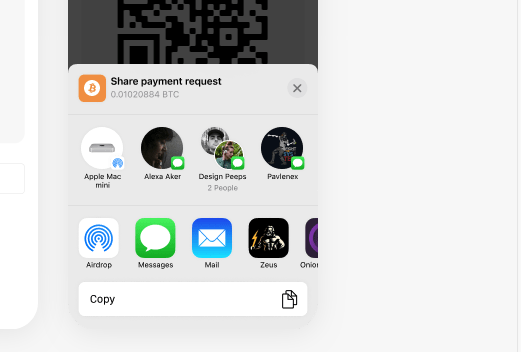
| ## Sharing the payment request |
There was a problem hiding this comment.
| ## Sharing the payment request | |
| ## Sharing the request |
There was a problem hiding this comment.
also with this one, i think its just clear to have the payment part in here. the payment request concept is something that will be in other places in this chapter I expect so might as well readers familiar with it.
There was a problem hiding this comment.
You decide. I think it's pretty clear from the page context that it's about payments but up to you.

Co-authored-by: Christoph Ono <chri@sto.ph>
Co-authored-by: Daniel Nordh <3393669+danielnordh@users.noreply.github.com>
Co-authored-by: bosch <55287964+Bosch-0@users.noreply.github.com>

9d2798d to
d802be1
Compare


|
Fixed merge conflicts, at least until another PR gets merged into master. |
Co-authored-by: Christoph Ono <chri@sto.ph>


Closes #174
Follow up page would touch on privacy of transactions including topics of wallet fingerprints (multisig vs signle sig), input/output ordering, coinjoins, and labeling to help users keep separate coin histories.